
National Action Agenda Batteries
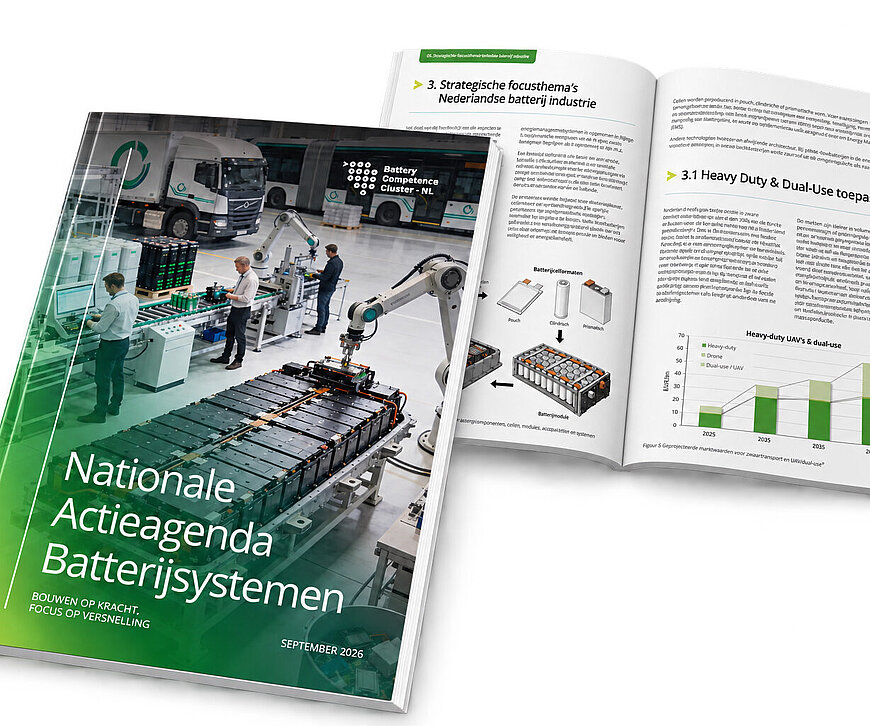

The Netherlands has entered a new phase in the development of its battery ecosystem. What began as an ambition to secure a position in the global battery value chain has evolved into a strategy focused on acceleration, industrialisation and long-term economic impact. The renewed National Action Agenda Batteries provides a shared roadmap for government, industry and knowledge institutions to transform Dutch battery innovation into scalable solutions that strengthen competitiveness, sustainability and strategic autonomy.
From Ambition to Acceleration
Since the publication of the first Battery Systems Action Agenda in 2022, the Dutch battery ecosystem has matured significantly. New companies have entered the market, public-private investments have increased and several pilot, testing and demonstration facilities have been established. At the same time, batteries have become more than an energy transition technology. They are now recognised as critical enablers of economic resilience, industrial competitiveness, energy security and defence capabilities.
The new agenda therefore represents a shift from a "call to action" to a "call to acceleration." Its primary aim is to ensure that Dutch battery innovations move faster from research and development into industrial production, market deployment and international value chains.
Building on Dutch Strengths
Rather than competing in large-scale commodity battery production, the Netherlands focuses on areas where it has a strong right to play. The country's strengths lie in advanced materials, production technology, system integration, circularity and application development, supported by a strong industrial base in transport, energy systems and high-tech manufacturing.
The agenda identifies five strategic focus areas where Dutch organisations can create the greatest impact:
- Heavy-duty and dual-use applications
- Stationary energy storage
- Next-generation battery materials and components
- Battery production equipment
- Circular battery value chains, including lifetime extension, repurposing and recycling
Together, these areas form the backbone of the Dutch battery strategy and create opportunities for innovation, employment and economic growth.
Seven Priorities for Growth
To translate ambition into action, the agenda outlines seven interconnected priorities that cover the entire innovation chain.
Accelerate Market Adoption: Innovations can only succeed when they reach customers. The Netherlands aims to support demonstrations, validation programmes, launching customers and regulatory frameworks that help new battery technologies reach the market faster. Heavy-duty transport, energy storage, aviation and defence applications are important first markets.
Create a Pathway from Innovation to Industrial Production:A major challenge remains bridging the gap between laboratory-scale innovation and industrial production. The agenda promotes stronger support for scaling battery materials, manufacturing technologies, recycling processes and production equipment into commercial applications.
Develop a Digital and Secure Battery Ecosystem: Future battery value will increasingly depend on software, data and digital infrastructure. Battery Management Systems (BMS), digital twins, data platforms and validation tools will support safety, lifetime optimisation and performance. The Netherlands aims to establish itself as a European leader in battery management, validation and certification.
Strengthen Circularity:Circularity is a central pillar of the strategy. Batteries should be designed for maintenance, repair, refurbishment and high-quality recycling. By extending battery lifetimes and recovering critical materials such as lithium and graphite, the Netherlands can build a strong circular battery economy and enhance European resource security.
Invest in Shared Infrastructure: Open-access research facilities, pilot lines, testing centres and production infrastructure are essential for scaling innovation. The agenda highlights the need for a flexible battery cell assembly facility and stronger connections between existing infrastructures such as the Open Battery Industrialisation Centre (OBIC) and national testing facilities.
Develop Human Capital: The battery transition requires thousands of skilled professionals. While researchers remain important, the greatest demand will be for operators, technicians, engineers and production specialists. The agenda calls for battery competencies to be integrated into existing technical education programmes, lifelong learning initiatives and practical training environments.
Strengthen European and International Collaboration: No country can build a complete battery value chain alone. The agenda therefore promotes active participation in European partnerships, innovation programmes and strategic international collaborations. By connecting Dutch strengths to European value chains, the Netherlands can accelerate growth while contributing to European strategic autonomy.
Looking Towards 2030 and Beyond
The National Action Agenda Batteries sets out a clear vision: by 2030, Dutch battery solutions should be widely deployed in strategic markets, Dutch innovations should be integrated into European value chains and the country should be recognised internationally for expertise in battery management, circularity, production technology and advanced materials.
Ultimately, the agenda aims to make the Dutch battery ecosystem more competitive, resilient and sustainable. Through coordinated action across government, industry and academia, the Netherlands has the opportunity to become a key player in Europe's battery future while creating lasting economic and societal value.
Download NAB in DUTCH (PDF)